
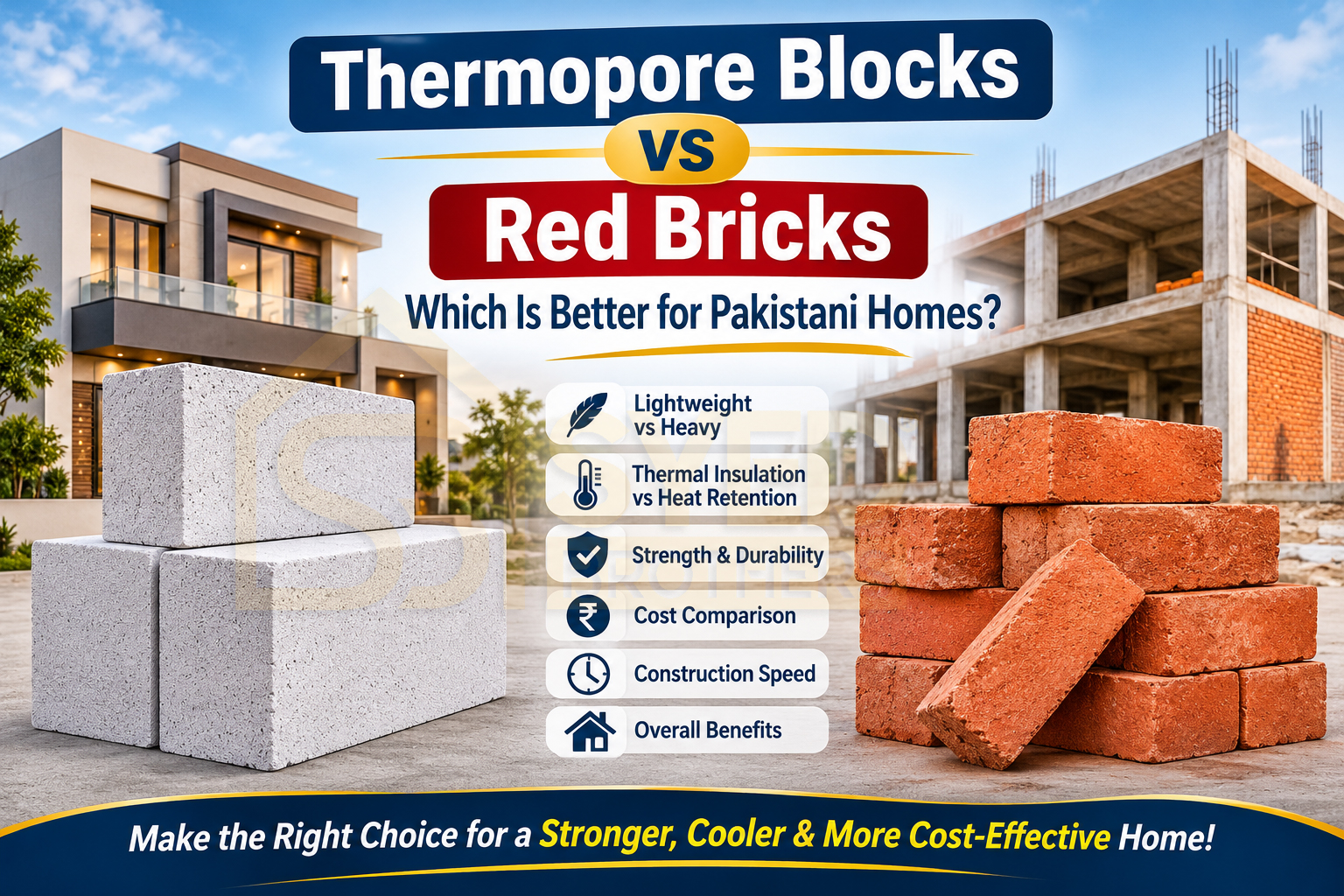
The thermopore blocks vs red bricks Pakistan debate has a simple reason behind it: electricity bills. Every summer, homeowners look for a wall that keeps heat out, and thermopore sellers promise exactly that. Red brick sellers answer with a hundred years of proof. Both sides are half right, which is why this question needs an honest answer instead of a sales pitch. Here is the short verdict. Thermopore blocks win on insulation, weight and speed, when they are used as infill inside a properly designed frame. Red bricks win on strength, familiarity, fire behaviour and ease of repair. Neither material is right for every wall, and the most important sentence in this guide is this one: thermopore blocks do not replace load bearing brick walls unless your structural engineer designs the building that way. Read the full comparison below, and if you want the answer for your own house and structure, Syed Brothers offers a free consultation with an itemized material comparison for your design.
Thermopore is the common Pakistani name for EPS, expanded polystyrene. Thermopore blocks are lightweight blocks or panels made from EPS, sometimes with a mesh and plaster or concrete skin system, used to build walls that are light and insulating. They belong to the wider family of lightweight construction blocks, which also includes aerated and cellular concrete blocks, all designed to reduce the dead load a building frame must carry. The key fact about them is structural: EPS blocks are infill material. In a framed structure, the concrete columns and beams carry the building, and the walls fill the frame. Thermopore blocks are made for that infill job. They are not a general replacement for structural masonry, and any project using them needs structural engineering services to confirm the wall system, the fixing details and the finishes.
Red bricks, clay bricks fired in kilns, are Pakistan's default wall material. In load bearing construction, brick walls carry the building's weight. In framed construction, the same bricks fill the frame. Every mason in the country knows how to lay them, every market stocks them, and every repair, from a new door opening to a plumbing chase, is a familiar job. Their weakness is the one driving this whole debate: solid clay brick conducts heat well, so a brick wall lets summer heat through and winter warmth out. Their strength is everything else: proven durability, good fire behaviour, solid fixing for shelves and fixtures, and easy local repair with local labour.
| Factor | Thermopore (EPS) blocks | Red bricks |
|---|---|---|
| Weight | Very light, less load on frame and foundation | Heavy, frame and foundation designed for it |
| Heat insulation | Strong, EPS resists heat flow well | Weak, solid brick conducts heat |
| Load bearing | Infill only, unless engineer designs otherwise | Proven load bearing tradition |
| Fire behaviour | Needs proper covering and detailing | Naturally fire resistant |
| Sound | Good with plaster and mesh system | Good, mass blocks sound |
| Build speed | Faster laying, larger units | Slower, smaller units, more joints |
| Fixing and repairs | Needs specified fixings, specialist repair | Any mason, any fixings, easy repair |
| Availability | Fewer suppliers, verify quality | Everywhere, every city |
Read the table and the pattern is clear. Thermopore wins the physics questions, weight and heat. Red brick wins the practical questions, strength, fire, repair and availability. Your decision should follow your structure type first and your climate second, not a slogan from either seller.
The heat resistance comparison is where thermopore earns its reputation. EPS has very low thermal conductivity, which means heat moves through it slowly. A thermopore wall therefore keeps the inner face cooler than a solid brick wall of similar thickness, and the room gains less heat through the wall. In a Pakistani summer, that is a real, felt difference, not a theory. Two honest qualifications belong here. First, the benefit depends on thickness and density: a thin, low density panel insulates far less than a thick, specified one, so compare products by their specification, not by their name. Second, walls are only part of heat gain. A thermopore wall under an uninsulated roof with west facing glass will not fix a hot house on its own. The insulated blocks vs clay bricks question is best answered as part of a whole envelope: walls, roof, shading and glazing together. Red bricks are not hopeless on heat either. A double brick wall with a cavity, good plaster and shading performs far better than a single exposed brick wall. But for pure insulation per inch of wall, EPS wins, and that is why it keeps appearing in new construction discussions.
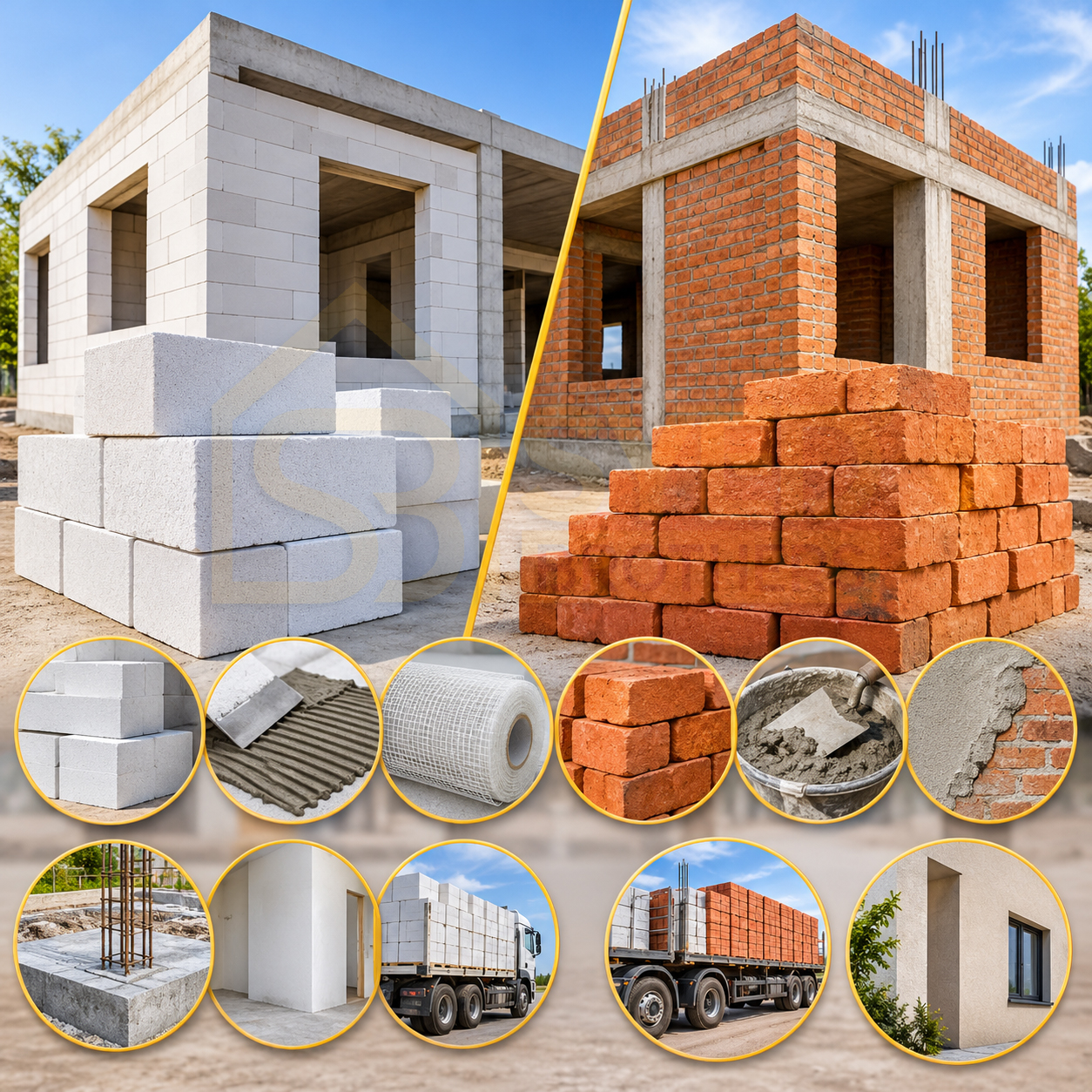
Cost of construction: thermopore vs bricks is the question that decides most projects, and it is also the question with the most misleading answers online. The honest comparison is whole wall cost, not unit price. Material: block or brick unit price, plus mortar or adhesive, mesh, plaster and finishing for the full wall build up. Labour: thermopore laying is faster per square foot, but needs workers who know the system, mesh and plaster detailing included. Frame: lighter walls can reduce frame and foundation demand, but only where the engineer designs for it. Never assume a saving the engineer has not calculated. Finishes and fixing: plaster, mesh, paint and fixture fixings differ between the systems, and the cheaper wall on day one can cost more in finishing. Transport and wastage: thermopore is light to transport but bulky and damage prone; bricks are heavy but hard to damage. On prices specifically: the red brick price in Pakistan 2024 figures still circulating online are stale, because brick rates move with kiln fuel, season and city, and 2024 numbers cannot budget a house today. Thermopore blocks price in Pakistan listings vary even more, by density, size, system and supplier, so a single online figure is meaningless without the specification behind it. For both materials, get dated written quotes for your exact specification and quantity, from suppliers in your city, and compare the full wall cost, not the unit price.
Red bricks vs EPS for 5 marla house is the most common version of this question, because 5 marla is the most common family plot. The answer follows the structure, not the plot size. If your 5 marla house is a framed RCC structure, EPS infill walls are a genuine option worth pricing: lighter walls, better insulation, faster construction. Ask your engineer to confirm the wall system, the mesh and plaster build up, and the fixing details for doors, windows and wall hung items. If your 5 marla house is load bearing brick construction, stay with bricks, because the walls are the structure, and swapping them for infill material without a redesign is not an option. Either way, price both options as complete walls for your covered area, including plaster and finishing, and judge them on total cost and comfort together. A 5 marla house is small enough that the wall decision affects every room, and large enough that a wrong choice is expensive to undo.
A fair guide must state the risks plainly, because sellers rarely do. Fire: EPS is combustible, so the wall system must be covered and detailed to the applicable fire and building requirements and the manufacturer's specification. Exposed or thinly covered EPS is not acceptable. Impact: thermopore walls dent and damage more easily than brick, so protection at low level, in corridors and in children's rooms matters. Fixing: heavy shelves, wall hung cabinets and air conditioner units need specified fixings into the wall system, not ordinary brick plugs. Workmanship: the system depends on mesh, plaster and joint detailing. Inexperienced teams produce cracked, hollow sounding walls that give the material a bad name it does not deserve. Acceptance: confirm with your engineer and your approving authority that the proposed wall system is acceptable for your project before ordering material. Do not discover an objection after the walls are up. None of these risks is a reason to reject thermopore outright. All of them are reasons to use it only with an engineer, a specified system and an experienced team.
Thermopore manufacturers in Lahore searches lead to a scattered market: factories, dealers, importers and small workshops, with widely varying quality. No honest guide can hand you a ranked list, because suppliers, densities and prices change constantly, and a list printed today is stale tomorrow. Instead, verify any supplier the same way you would verify any building material supplier. Ask for the product specification in writing: density, size, compressive strength and fire classification, as applicable to the product. Visit the factory or yard and inspect stock: consistent size, clean edges and uniform density are visible quality signs. Ask for past projects you can visit or owners you can speak to, and look at walls that are at least a year old. Get a dated written quote that names the exact product, density and quantity, with delivery and wastage terms. Confirm the fixing, mesh and plaster system the supplier recommends, and confirm it with your engineer before ordering. The same verification discipline applies to every material decision in your house, which is why material selection sits inside our grey structure construction planning, not as a last minute purchase. Your engineer confirms the system, and the estimate follows the confirmed system.
Wall material decisions go wrong when they are made on price alone or on a seller's promise. Syed Brothers decides them on structure, climate and whole wall cost, in that order. Engineer first: the wall system is confirmed by the structural design before material is ordered. Whole wall pricing: material, labour, mesh, plaster and finishing quoted as one comparable figure. Experienced teams for both brick and modern wall systems, with supervision that checks detailing before it is covered. Whether you are planning house construction in Lahore or house construction in Islamabad, the method is identical: design first, material second, price third. That discipline runs through our turnkey construction services, and every project starts with our house design services and a design consultation, so your wall decision is made on your structure and your climate, not on a brochure.
Are thermopore blocks good?
Are thermopore blocks good? For the job they are designed for, yes: lightweight, insulating infill walls inside a framed structure, built to a specified system. They are not a universal replacement for bricks, and they are not suitable as load bearing walls without engineering design.
Can thermopore blocks replace red bricks completely?
Only where the engineer designs the building for it. In framed structures, EPS infill can replace brick infill. In load bearing construction, the brick walls are the structure, and they stay.
Which is cheaper, thermopore or bricks?
It depends on the whole wall cost: material, labour, mesh, plaster, finishing and any frame effect the engineer calculates. Compare complete wall quotes for your house, not unit prices from the internet.
Which wall is cooler in summer?
A specified thermopore wall insulates better than a solid brick wall, so the room stays cooler through the wall. But the roof, windows and shading matter as much, so judge the whole envelope, not one wall type.
So, thermopore blocks or red bricks? Here is the recap. Choose thermopore infill if your structure is framed, your engineer specifies the system, and insulation and speed are your priorities. Choose red bricks if your structure is load bearing, or if fire behaviour, easy repair and proven familiarity matter most. Choose on whole wall cost and comfort, never on a unit price or a seller's promise. Never decide without your structural engineer. The wall system follows the structure, not the advertisement. If you want the answer for your own house, get a free material estimate from Syed Brothers. Tell us your structure type, covered area and city, and we will price both wall options as complete walls, so you can decide on numbers you can trust. Which wall would you trust for your children's bedroom, and why?
Finishing (Interiors & Exteriors). Syed Brothers Designers & Builders, as the best construction company in Pakistan..
Copyright © 2026 Syed Brothers | All Rights Reserved
Leave Comments